
Imagine that AI prompt engineering has disappeared, and anyone with a single thought can have AI produce a logically tight, smooth-flowing, perfect plan in seconds.
In that world where “perfection is readily available,” the streets are full of 100-point copy, yet you didn’t leave work early, but instead feel more anxious than before.
So what value is left for us as human beings?
Why Has "Perfection" Become the New Mediocre?
Before AI became popular, writing articles, doing analysis, and expressing oneself fluently were huge advantages.
But AI instantly raises everyone’s expression standard from 20 points to over 90 points.
The problem then arises: when everyone can ask AI and get the same perfect answer, this answer becomes a commoditized product.
Book Outlet founder Waki says:
| Type | Features | Source of Value |
|---|---|---|
| Commodity | Standardized, generic, and mass-reproducible, like bottled water or ballpoint pens | Meets basic needs, with very low unit price and emotional value |
| Work | Infused with personal or organizational taste, design, and soul | Generates resonance, a sense of story, and trust, with extremely high value |
In the past, a score of 100 was a symbol of excellence; now, a score of 100 is just the threshold for entering the market.
When the scale of measuring excellence is raised from 100 to 1000 points, the true differentiation lies not in whether you "can produce," but in whether you can inject something that others don’t have.
What We Buy is Never Knowledge, but "Trust"
Why does content purely produced by AI, though correct and error-free, often make people want to swipe away immediately?
This stems from a reflexive sense of neglect. Just like automatically ignoring banner ads when browsing webpages, our intuition can accurately detect that AI feel lacking in warmth.
A deeper reason is the lack of accountability.
If the advice given by AI is wrong, it won’t feel ashamed, and does not need to bear any consequences.
We don’t easily place true trust in a system that is not responsible for the results.
We do not buy into objective scientific facts; we buy into the person conveying the facts.
We buy your story, the pitfalls you fell into, and the process of you overcoming all difficulties.
Knowledge is already overabundant, but what moves us and makes us willing to take action is always that person who bears a reputation and is genuinely living.
Taste is Your Filter: From "Memory" to "Sensor"
In the AI era, "storing knowledge" is no longer valuable.
AI has the memory of the entire world; what it gives you is the average of all data. In contrast, humans should see themselves as a sensor.
In the information flood of AI, taste is your ability to choose what to keep and what to let go
Waki proposed a concept:
Don’t build memory, build your sensing.
The so-called taste is actually a precise filter. It decides what you choose to look at, what you reject, and what you care about.
AI pursues consensus and average, while humans pursue extreme values, which are your unique perspective and aesthetics.
When you filter information through personal choices, biases, and real experiences, you can sublimate cold commodities into works that resonate with people.

Stop Treating AI as a Wishing Well: Use "Four Quadrants" to Clarify Needs
Knowing the importance of taste, the next question is, how to stably inject taste into AI output?
Many people use AI like rolling dice; sometimes amazed, sometimes mediocre, the critical hit rate depends entirely on luck.
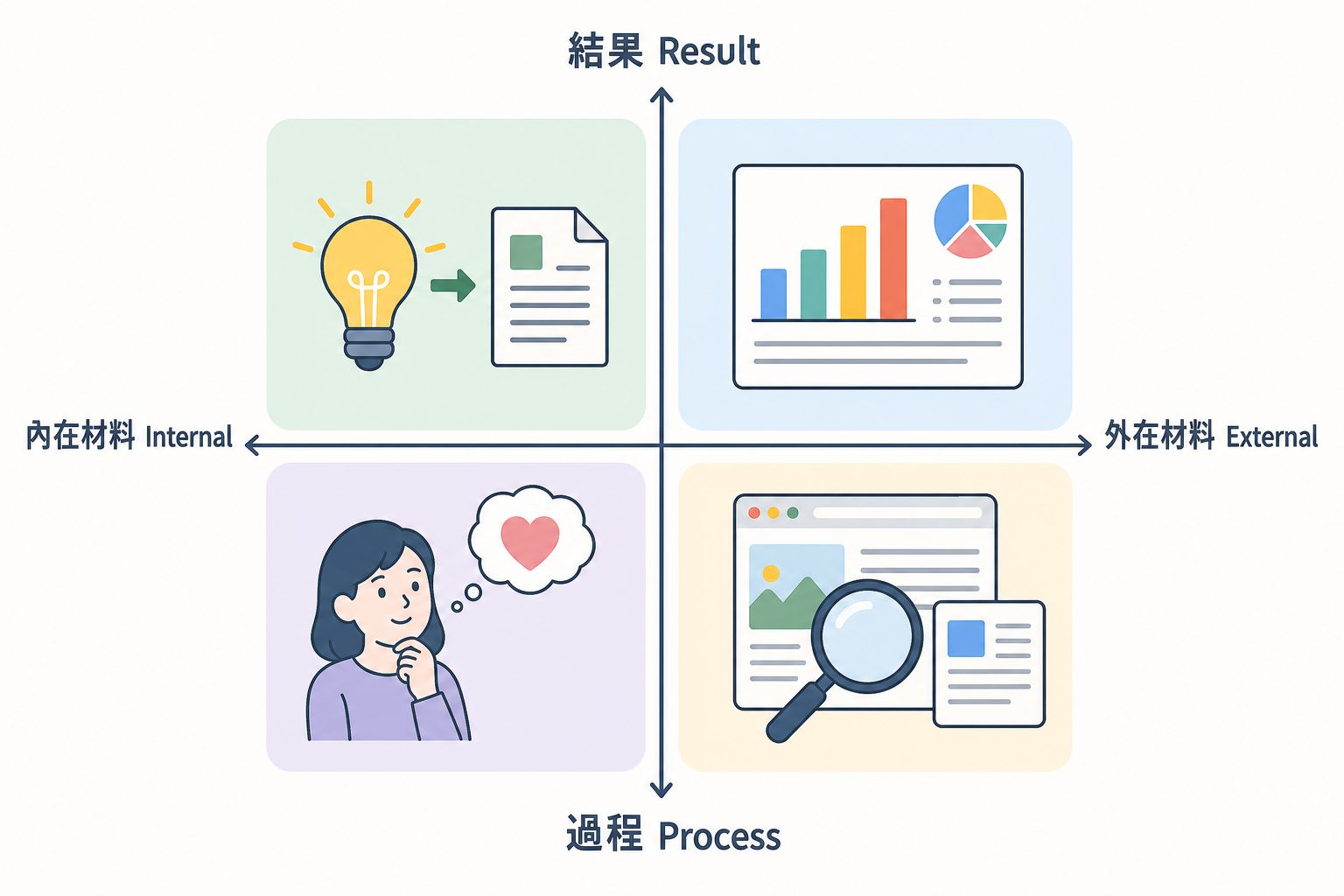
Waki’s first solution is to first clarify "what do I really want from this conversation". Break down AI collaboration into four quadrants composed of two dimensions.
| Dimension | Explanation of Both Ends |
|---|---|
| Material Source (X-axis) | Internal Material (your story, views, experiences) vs External Material (web data, research reports) |
| Dialogue Goal (Y-axis) | Pursuing Results (producing presentations, reports) vs Enjoying Process (clashing of thoughts, self-awareness) |
For example, making a decision-making report for work belongs to External Material + Pursuing Results.
In this case, you don’t need to put in too much personal emotion and bias; the focus is on interacting with external materials to produce results.
Conversely, if you want to have a dialogue with your inner self, that is Internal Material + Enjoying Process, which requires structured sorting of feelings.
Just establishing these two dimensions will instantly clear up your use of AI, and you won’t derail the conversation every time.
Build "Project Packs" to Think Outside the Box Within the Box
After clarifying the quadrants, Waki’s second solution is to build a dedicated Project Pack.
The so-called project pack is to proceduralize and modularize what you do most often, turning it into a set of reusable guide steps. It is already filled with your taste, judgment, and experience.
| Project Pack Type | Corresponding Quadrant | Purpose |
|---|---|---|
| Presentation Project Pack | External Material + Results | Integrates classic book frameworks to generate logically tight outlines and drafts |
| Study Note Project Pack | External Material + Process | Transforms messy speech summaries and highlighted key points into notes with personal inspiration |
| Opinion Work Engine | Internal Material + Results | Transforms personal core viewpoints into convincing articles or messages |
Every time you throw the materials in and crush and recombine them step by step through a fixed process, the output is no longer a mass commodity, but a work with your soul.
Many people worry that proceduralizing thinking will make the output rigid. Waki’s view is exactly the opposite.
It is when we work within frameworks that we are more likely to have out-of-the-box thinking.
This approach will pull your critical hit rate from 10% to nearly 100% of stable output. When a result is not as expected, you won’t blame yourself, but instead go back to optimize this process.
Why Does Higher Efficiency Make You Live More Tired?
After you fill up efficiency with taste and project packs, you will encounter an unexpected trap.
Have you noticed that AI tools have multiplied efficiency several times, yet we have never left work early, but have instead been stuffed with more tasks?
This is actually a huge efficiency trap.
When corporations or individuals target maximizing production, the time AI saves for you will only become a tool for you to do the next 10x project.
Waki shared a story of a friend.
That friend was so busy with work that they could only watch movie recaps like "Movie Explained in 10 Minutes."
This is the ultimate manifestation of the efficiency trap: in order to save time, we discard the most precious sense of experience.
Even more dangerous is that AI instantly gives you a report, but you are still the one who has to read it, judge it, and make decisions.
If you drive yourself with the logic of "maximizing profit," you will only be crushed by endless demands.
So you have to read more AI-generated reports, living more painfully than in any past era.
The Ultimate Goal of Efficiency is "Happiness": Give Time Back to Real People
So, what is the ultimate goal of efficiency?
Waki’s answer is simple: happiness.
Tools should serve our sense of happiness, rather than turning us into higher-order production machines.
He even changed his company’s goal from "maximizing profit" to maximizing personal happiness.
Then what should the saved time be used for? The answer is those areas that AI cannot replace.
| Things Worth Investing In | Concrete Practices |
|---|---|
| Deep Human Interaction | One-on-one exchanges, community dialogues, book clubs |
| Real Life Experience | Traveling, sports, spending time with family |
Waki admitted that he was originally an introvert, but after releasing his time from work, he instead began exchanging deeply one-on-one with people in large quantities.
In a future filled with AI, the only dialogue we ultimately want to trust and participate in is with humans.

In a Perfect World, Retain Your Imperfection
If there was a machine that could instantly stuff the essence of a hundred books into your head, would you want it?
Waki’s answer is to refuse. Because when you have all the answers, you lose curiosity and confusion, both of which are the driving forces of human progress.
When you care about everything, you actually care about nothing; only when you care about only a few things do you genuinely care.
In a future where AI can easily achieve 100 points, the most valuable part of humans is instead those ‘imperfect’ things.
| Irreplaceable Asset | Explanation |
|---|---|
| Real Pain and Struggle | The process of getting confused and making mistakes is the source of creativity and trust |
| Uncopyable Soul | Includes your biases, risk-taking, and unique life stories |
| Active Right of Choice | Under limited resources, decide where to focus your attention |
Don’t be afraid that your output is not perfect enough.
When everyone is chasing the machine’s 100 points, the sense of reality that can be confused, struggle, and care is your most precious moat.
Because your soul is originally irreplaceable.