In daily life, we often hear things like “this place has good feng shui, that’s why it’s popular” or “this is the will of God.”
What exactly is superstition? And how can we confirm that we are clear-headed modern individuals?
In fact, what we take for granted today as science was not originally born to oppose religion, but rather emerged from a philosophical revolution about causality.
This was the most radical “brain system reinstall” in human history, teaching us how to distinguish what is real from what are fabricated claims amidst a chaotic world.
The Causal Showdown Between Superstition and Science: Are You Being “Lazy”?
People often associate superstition with religion, but at its cognitive core, superstition is essentially a blind and lazy attitude toward the “causality” of things.
Imagine someone claiming that their video views skyrocketed because they moved into a “feng shui hotspot” — this is a form of mysterious causality
Two things are forcibly linked together, with the process in between being vague and unverifiable.
In contrast, the transparent causality of science would attempt to analyze: a better environment improved the creator’s mood and energy, which in turn produced quality content and eye-catching thumbnails, ultimately leading to increased traffic.
Every step in between is intuitive and can be broken down.
| Thinking Trait | Superstitious Thinking | Non-Superstitious (Scientific) Thinking |
|---|---|---|
| Causal Explanation | Mysterious, vague, inexplicable | Transparent, intuitive, rigorous |
| Verification Method | Based on belief, “better safe than sorry” | Experimental observation, controlled variable method |
| Attitude | Blind belief, establishing false connections | Systematic investigation, seeking direct causes |
To break superstition’s closed logic of “everyone else is wrong, only I am right,” modern science introduced the controlled variable method.
It requires us to stop relying on intuition and instead find the most direct, most transparent connections through rigorous processes.
From “Divine Will” to “I Think, Therefore I Am”
Have you ever suspected that the world you perceive, including history and traditions, might all be an elaborate hoax that was fabricated?
This sounds like a plot from The Matrix or a science fiction movie, but over four hundred years ago, a philosopher named René Descartes seriously conducted this thought experiment that shook human history.
Before we dive into Descartes’ mind, let’s first look at how people thought at that time.
During the ancient Greek period, humanity’s questions about the world were actually very pure, driven by curiosity about nature.
But by the Middle Ages, the center of cognition underwent a massive shift
The starting point of everything was no longer “I,” but “God”.
| Era | Cognitive Center | Way of Questioning |
|---|---|---|
| Ancient Greece | Nature and Self | What is this world? How can I understand it? |
| Middle Ages | God (the Almighty) | Why did God arrange things this way? What is God’s intention? |
Within the medieval framework of thinking, if you wanted to understand the world, you first had to understand the source of the world — “God”.
Therefore,
the Biblebecame the sole foundation for studying nature.
When all knowledge exploration was directed toward the invisible, intangible realm of souls and theology, the natural knowledge of the material world naturally fell into stagnation.
If people fell ill in those times, the explanation was often “possessed by demons” or “God’s punishment”, because there was not yet a set of “transparent” rules to explain how nature works.
Descartes’ “Systematic Doubt”: The Brain Reinstall Plan
Facing a knowledge system riddled with unexamined and even erroneous beliefs, Descartes realized that without thoroughly purging these “cognitive viruses,” it would be impossible to build a solid edifice of truth.
So he decided to conduct an extreme “brain system reinstall.”
He hypothesized: what if there were an extremely cunning, all-powerful demon creating a grand illusion to deceive humanity? In a state where even your body, even heaven and hell might be illusions, what could still be “absolutely real”?

After painful deliberation, he finally discovered the one reality that could not be altered
The very act of “I am thinking” cannot be fabricated.
Even if the demon could deceive his senses, it could not deceive a being that “is currently doubting whether it is being deceived”.
This is the origin of that famous saying we often hear:
“I think, therefore I am” (Cogito, ergo sum)
From “Religious Dogma” Back to “Independent Thinking”
This turning point was profoundly significant for human civilization, bringing about the following changes.
| Change | Significance |
|---|---|
| Shift of the Cognitive Foundation | The starting point of cognition shifted from the external “religious dogma” back to the individual’s “independent thinking”. |
| Rejection of Blind Obedience | No longer unconditionally accepting any unverified authoritative indoctrination — all knowledge must start from scratch, derived through rational reasoning. |
| Awakening of Free Thinkers | This revolution inspired countless Free Thinkers in later generations, empowering humanity to dare to question established authority. |
It was as if we could originally only see the world through the Church’s filter, and now Descartes told us:
You can remove the filter and use your own mind to analyze data and observe phenomena.
The Transfer of Authority: When “Transparent Rules” Replaced “Priests”
In the Middle Ages, the right to interpret knowledge was monopolized by the Vatican. People deduced the workings of the world through parsing the textual logic of the Bible (such as the concept of “purgatory”).
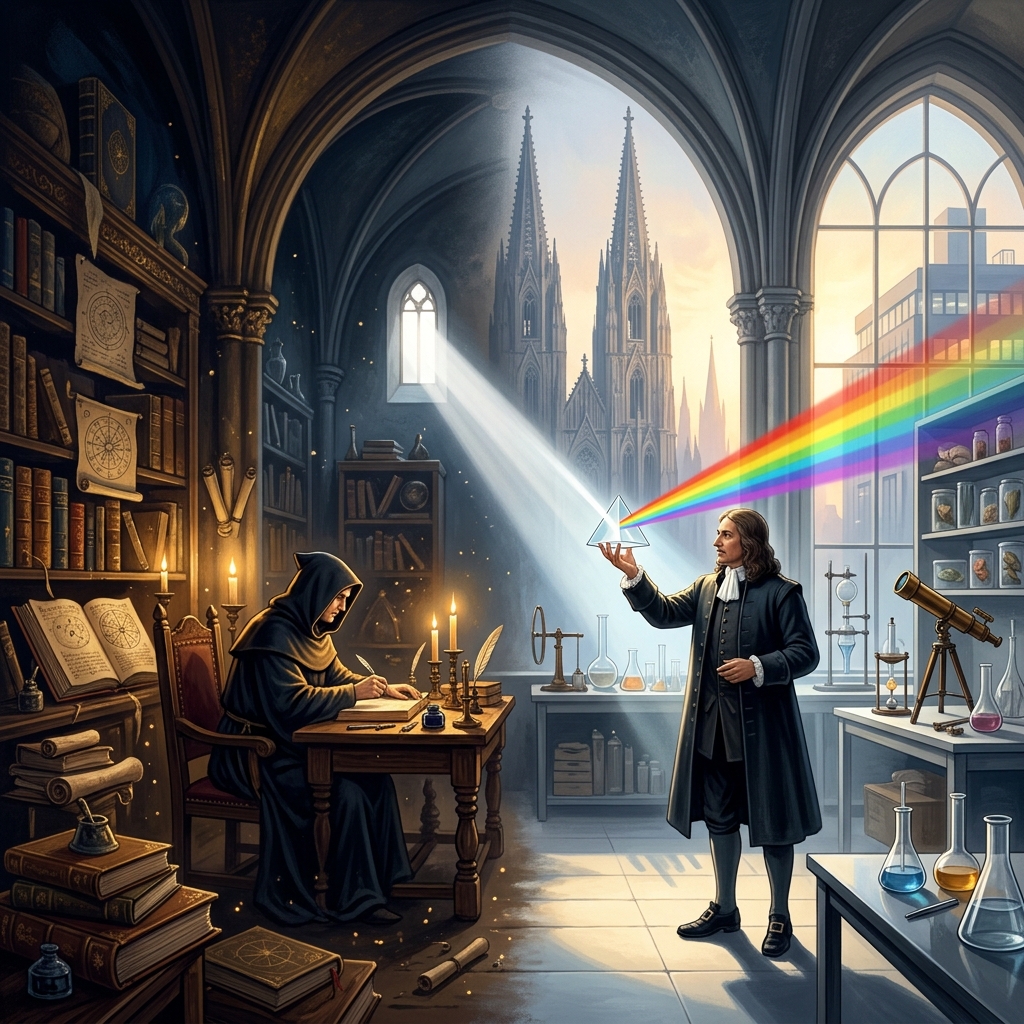
Newton and others cleverly avoided grand ultimate questions like “why does the world exist,” and instead tackled small, visible problems like “how rainbows form”.
When Newton used a prism to prove that rainbows originate from the refraction of light rather than a mysterious divine covenant, he demonstrated an extremely compelling form of transparent causality.
This methodology immediately produced a transfer of power:
Whether knowledge can be disseminated is no longer decided by the will of the Church, but by the “rules of science” (methodology) themselves.
As long as conclusions are reached through the proper process, anyone can become a publisher of knowledge.
Is Philosophy the End of Science?
Have you ever heard the saying: “The end of science is theology”?
This phrase is often used to describe how top scientists (such as Newton or Einstein) seemed to turn toward religion or philosophy after exploring to the extreme.
This confuses many people: Isn’t science supposed to eliminate superstition? Why does it seem to circle back at the end?
In reality, this is not a form of “regression,” but rather a profound exploration of cognitive boundaries.
To understand this, we must first clarify three concepts that are often conflated: superstition, religion, and science.
Superstition, Religion, and Science: Can You Really Tell Them Apart?
In many people’s eyes, these three seem to be at opposite ends of a spectrum — science on one end, religion and superstition on the other.
But if we return to the origins of science, we find that their relationship is far more interesting than imagined.
First, let’s set the record straight for “religion”:
Religion is not the same as superstition.
| Type | Core Characteristic | Attitude |
|---|---|---|
| Superstition | Blindly establishing false causal connections | Lazy, closed-minded, refusing examination |
| Religion | Providing a grand worldview and value system | Pursuing ultimate meaning and spiritual sustenance |
| Science | Seeking transparent, verifiable causal rules | Rigorous, open-minded, welcoming falsification |
The essence of superstition is a “lazy view of causality”.
For example, you may have heard “business boomed because we moved to this office.” This kind of claim forcibly links two unrelated things, with the process in between being vague and unverifiable.
The early pioneers of science, such as Newton and Descartes, were themselves devout believers.
Their original intention was not to oppose God, but to oppose the lazy attitude of “mystifying” natural phenomena.
They believed that the world created by God has rules, and humanity’s mission is to discover these transparent rules.
Why Is a Scientist’s Highest Degree Still Called “Doctor of Philosophy (PhD)”?
To this day, the highest degree in science and engineering is still Doctor of Philosophy (PhD), which is not merely a historical relic but a tribute to science’s lineage.
In ancient Greece, “philosophy” originally meant the love of wisdom, encompassing all of humanity’s questions about the world.
Early science was classified as natural philosophy. It was not until the 19th century, as knowledge in various fields (physics, chemistry, biology) became vast, that Science formally became independent from its philosophical parent. Modern science is the fruit that this philosophical revolution bore in the material realm.
Once people reclaimed the autonomy of “independent thinking,” scientists began to focus their attention on visible, tangible, specific problems.
They used reason and empirical evidence to replace the previously mysterious, vague explanations.
This is also why, to this day, the highest degree in science and engineering is still called Doctor of Philosophy (PhD, Doctor of Philosophy).
This is a tribute to science’s lineage: the source of all science remains that philosophical spirit of daring to question without preconceptions.
| Stage | Characteristic | Impact |
|---|---|---|
| Philosophical Parent | Daring to question, free of preconceptions | Providing the driving force for doubt and thought |
| Scientific Independence | Focusing on objective laws, empirical evidence | Establishing global consensus in the material world |
Retaining the title of PhD serves as a reminder to every researcher: despite the subdivision of disciplines, the source of all science remains that
philosophical spirit of daring to question without preconceptions.
The Hegemony of the Material World: How Did Science Build Global Consensus?
The reason science has achieved absolute authority in modern society is that it made a very clever decision:
Temporarily abandon the exploration of “ultimate meaning” and instead solve “specific mechanisms”.
Before Newton, people might have explained rainbows as “God’s covenant” or some supernatural omen. These explanations were beautiful, but they offered no practical help in understanding how rainbows actually form.
Newton used a prism to prove that white light can be decomposed into the seven colors of the spectrum — this is a form of transparent causality. This methodology brought about tremendous changes:
| Change | Explanation |
|---|---|
| Demystification | Any phenomenon can be broken down through experiments and logic, no longer accepting unverified mysterious explanations. |
| Falsifiability | Any claim must be questionable and testable. |
| Democratization of Knowledge | As long as scientific rules are followed, people from different backgrounds can reach consensus in the material world. |
As long as you follow this protocol, regardless of your background, status, or beliefs, everyone can participate in the production and oversight of knowledge.
No matter where you are or what religion you believe in, the logic governing your phone’s chip operates the same way.
Science has successfully liberated humanity from the fear of the unknown, illuminating the natural world with transparent logic.
The Limits of Science: When We Begin to Ask About “Meaning”
However, this powerful tool is not omnipotent. Science is a system for handling the material laws of “the visible and tangible”, requiring everything to be falsifiable.
This leads to an interesting phenomenon:
Science is unmatched in solving “How” questions, but appears powerless when answering “Why” questions.
Imagine — science can precisely tell you:
- Which chemical substances the brain secretes when generating the feeling of “love” (
dopamine,oxytocin). - What the frequency of brain waves is when consciousness emerges.
But science cannot tell you:
- What is the meaning of this love?
- Why you, and not someone else?
- What is the essence of consciousness?
When questions involve abstract domains such as consciousness, the soul, and the meaning of life, scientific methods often find it difficult to intervene. This is the boundary of science.
Returning to the Philosophical Parent: Why Do Top Scientists End Up Contemplating Philosophy?
This is why the highest degree in science and engineering is still called Doctor of Philosophy (PhD).
This is not merely a historical relic, but a reminder to every researcher:
Science was always a fruit that branched off from the great tree of philosophy.
When scientists explore the limits of the material world and find that existing experimental tools can no longer push forward, they inevitably return to the embrace of philosophy.
This is not because they have become superstitious, but because they have arrived at the edge of knowledge. There, they must re-examine the starting point of cognition:
- How can we be certain that what we observe is the truth?
- Is there some kind of preset logic behind the order of the universe?
Just as Descartes once reclaimed the independently thinking “self” through “systematic doubt,” modern people in today’s materially abundant world need this kind of philosophical reflection even more.
Conclusion: A Weapon for Staying Clear-Headed in Chaotic Times
Modern science is not merely a pile of cold data — it is a survival weapon that protects us from being “trapped” by unexamined causal claims.
In a modern society filled with chaotic claims and algorithm-driven feeds, maintaining the scientific spirit of pursuing transparent logic is the true mark of being clear-headed.
The birth of modern science was essentially a cognitive revolution of “reclaiming the self.” It reminds us:
Do not easily surrender your right to think, and do not let your mind be trapped by unexamined causal claims.
In this age of information explosion and rampant rumors, maintaining Descartes-style questioning spirit is the most powerful survival weapon.
Only by maintaining the ability to independently question and challenge can we be truly clear-headed individuals in this chaotic world.
Science has cleared the fog of the material world for us, sparing us from the suffering of superstition, but for the ultimate meaning of spirit and life, we still need to explore on our own with the wisdom of philosophy.
Do not easily let your mind be “trapped” by unexamined causal claims, nor should you forget your curiosity about the meaning of life while pursuing material laws.
At the intersection of the material and spiritual, maintaining both reverence and clarity is perhaps the most elegant posture for us as “modern people.”