Imagine walking under the sunshine, gazing at the rainbow hanging in the sky after a rain shower — everything feels so natural, so taken for granted.
In Newton’s era, people finally understood that light could be broken down into a spectrum of vibrant colors, and scientists confidently believed that the universe was like a precisely operating clock — as long as you mastered the laws, everything could be predicted.
But just as the grand edifice of physics seemed complete, the microscopic world played an enormous joke on humanity.
Let’s see how this “quantum revolution” unfolded.
The Collapse of Classical Physics: Two Dark Clouds over a Perfect Sky
At the end of the nineteenth century, physicists were living quite comfortably. Maxwell’s electromagnetic field theory perfectly explained the wave nature of light, and everyone felt that physics had reached its endpoint.
But the towering figure of the physics community at the time, Lord Kelvin, pointed out that two “dark clouds” still floated over the clear sky of physics.
One of the most fatal dark clouds was called the ultraviolet catastrophe.
Scientists at the time discovered that when using classical physics formulas to calculate the energy of thermal radiation from objects, they arrived at an absurd conclusion:
As frequency increases, the energy tends toward infinity.
This meant that the heater in your home should be blasting out destructive ultraviolet rays or even gamma rays.
Clearly, experimental data brutally debunked classical theory.
The Birth of Quantum: Energy Is Not a Continuous River
Just when everyone was at a loss, Planck stepped forward. He proposed a hypothesis that seemed extremely bizarre at the time:
Energy is not continuous like flowing water, but comes in discrete, individual “packets.” He called this smallest unit a
quantum.
It’s as if we originally thought energy was a smooth ramp, but Planck told us it’s actually a staircase.
Subsequently, Einstein borrowed this concept and successfully explained the photoelectric effect.
He confirmed that light is not merely a wave — it also has particle properties (photons).
This quantum revolution had officially begun.
The Double-Slit Experiment: The Chameleon of the Microscopic World
If energy being discontinuous was strange enough, then the double-slit experiment will completely shatter your worldview.
Scientists discovered that when we send electrons through two narrow slits, they produce “interference patterns” on the screen — a characteristic unique to waves.
This means that when no one is watching, electrons pass through both slits “simultaneously” like waves.
This is the famous wave-particle duality
Microscopic particles are both waves and particles.
The Observer’s Gaze: Can Reality Actually “Collapse”?
The most eerie thing happened. When scientists tried to see exactly which slit the electron passed through by placing a detector next to the slits, the interference pattern disappeared!
The electrons obediently reverted to particles, passing through only one slit.
This tells us a shocking fact: The act of observation itself affects reality.
The Survival Law of All Things: The Magical “Superposition”
Imagine you have a coin. In the macroscopic world, when a coin lands on a table, it’s either heads or tails — it’s absolutely impossible to be “both heads and tails at once.” But in the microscopic quantum world, the rules completely change.
Before microscopic particles (such as electrons) are observed, they don’t occupy a definite position — instead, they simultaneously exist in a superposition of multiple possibilities.
Physicists gave this state a cool name — “superposition”.
Once observed, it instantly “collapses” into a definite state.
Why Is This So Astonishing?
According to quantum mechanics, electrons in motion don’t travel in straight lines like tiny balls, but spread out like a diffusing “wave”.
They’re not “possibly here” or “possibly there” — they are “simultaneously here and there”.
In that invisible microscopic foundation, everything actually exists in a hazy, undefined probability cloud.
The Observer’s Gaze: Do You “Create” Reality?
If everything is in superposition, why do objects we see in everyday life have definite positions?
This leads to the most eerie yet fascinating discovery in quantum mechanics: the observer effect.
In the famous “electron double-slit experiment,” scientists discovered:
| State | Description |
|---|---|
| When no one is watching | Electrons exhibit wave-like properties, passing through both slits simultaneously, producing interference patterns. |
| When a detector is placed to “watch” | Electrons seem to “sense” the observer’s gaze, the interference pattern instantly disappears, and electrons obediently become individual particles, passing through only one slit. |
This phenomenon is called “quantum collapse”.
In other words, at the very moment of measurement, the chaotic probability wave instantly “collapses” into definite reality.
What does this mean?
This implies a profound philosophical shock: Reality is not an existence independent of us, but a result co-created by our “gaze”.
Schrödinger’s Cat That Is “Both Dead and Alive”
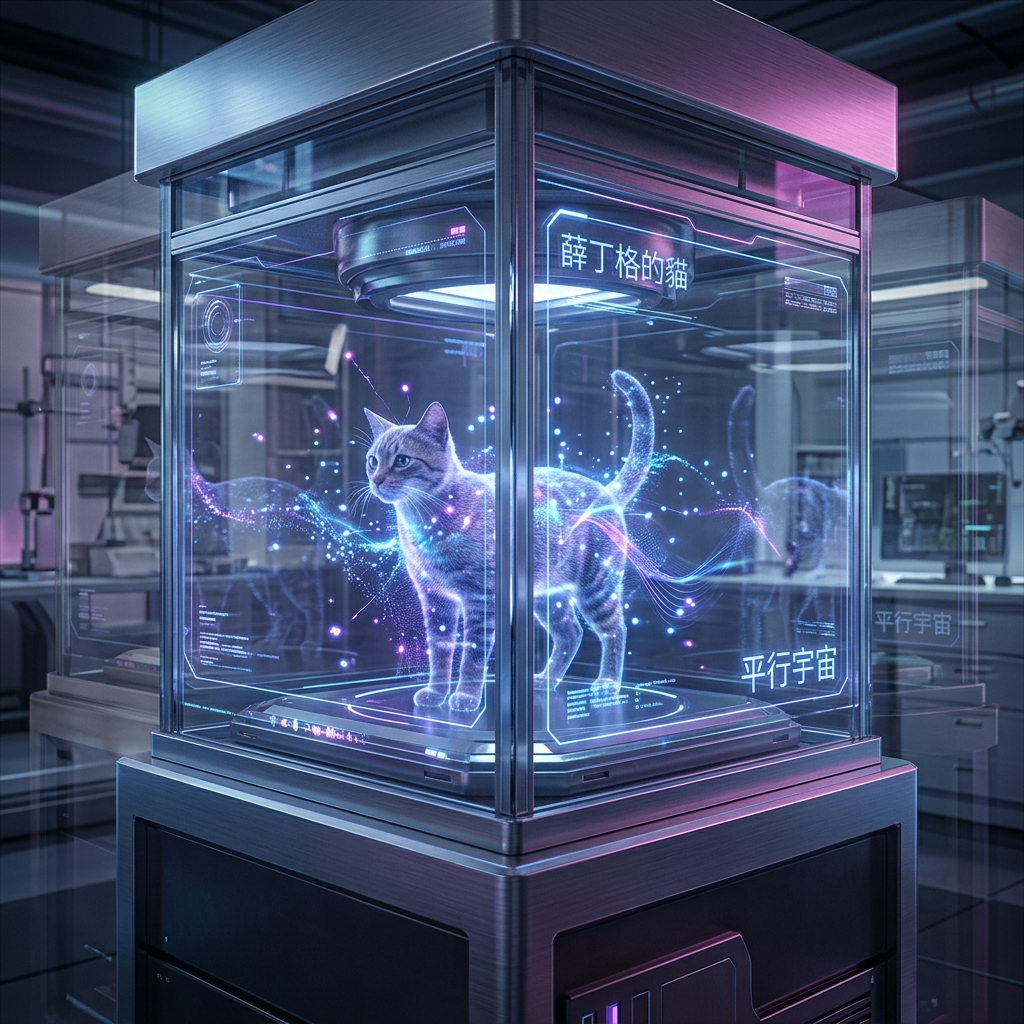
To satirize the absurdity of “observation creates reality,” physicist Schrödinger (Erwin Schrödinger) proposed a famous thought experiment — the well-known “Schrödinger’s Cat”.
He imagined locking a cat in a box with a poison gas device, where whether the poison is released depends on the decay of a microscopic particle (a random quantum event).
| State | Description |
|---|---|
| According to quantum theory | Before opening the box to observe, the microscopic particle is in a superposition of “decayed” and “not decayed”. |
| Deduced result | Through a chain reaction, the cat inside the box should also be in a superposition of “both dead and alive”. |
The core of this experiment lies in probability.
In the quantum world, the cat simultaneously exists in a superposition of “alive” and “dead”
| State | Description |
|---|---|
| Before observation | The cat and the atom are in an “entangled” state — the cat is also “both dead and alive.” |
| After opening the box | The act of observation causes the state to immediately collapse into a single reality. |
Schrödinger originally intended to prove the absurdity of applying quantum theory to the macroscopic world, but unexpectedly, this cat became the perfect mascot of quantum mechanics.
It forces us to think: Where is the boundary of observation? What is the line between the macroscopic and microscopic?
From a Single Reality to Infinite Possibilities
If reality is composed of a series of “collapses”, then isn’t our life also full of such wondrous turning points?
Some believe that each quantum event’s choice doesn’t cause reality to collapse, but rather causes the universe to “split”
This is the so-called “many-worlds interpretation” (parallel universes).
In one universe, the cat is alive; in another universe, the cat is dead.
Although we currently cannot prove the existence of parallel universes, quantum mechanics tells us an undeniable fact:
The world is not a clock running with mechanical precision, but rather an ocean filled with probability and choice.
Understanding Parallel Universes Through “Schrödinger’s Cat”
Have you ever fantasized that at some crossroads of fate, if you had made a different choice, what would your life look like now?
In the 2013 film “Coherence”, the characters fall into countless intertwined realities because of a tiny choice — picking up a “blue” or “red” glow stick.
From the Marvel Universe’s Multiverse to “Ant-Man”’s Quantum Realm, “quantum mechanics” and “parallel universes” have become every sci-fi fan’s favorite go-to trump card of “when in doubt, quantum mechanics.”
Decoherence: Why Can’t We See Parallel Universes?
If you think “both dead and alive” is too outrageous, physicist Hugh Everett proposed an even crazier explanation in 1957:
Reality never collapses. This is the famous Many-Worlds Interpretation.
He believed that when you open the box, the universe actually “splits” into two. In one universe, you see the cat alive; in another universe, another you sees the cat dead. These two realities coexist simultaneously, but are completely independent of each other.
So why don’t we normally feel this splitting? This is what’s known as decoherence.
| Concept | Description |
|---|---|
| Superposition | Microscopic particles, before being observed, can simultaneously possess multiple states |
| Decoherence | Macroscopic objects (such as people, cats), due to their enormous mass, have extremely short wavelengths, and rapidly lose quantum properties upon contact with the environment |
| Quantum entanglement | Two particles, even if separated by light-years, can instantaneously sense each other’s states |
Imagine that our reality is actually a smooth river, but the quantum world is “pixelated.”
Although everything has wave-like properties, the greater an object’s mass, the shorter its wavelength — so short that in the macroscopic world it becomes completely unobservable.
Because we are too large, too “heavy”, these tiny quantum effects are canceled out at macroscopic scales, allowing us to see only a single path.
For our vast macroscopic world, quantum effects are disrupted by countless molecules in the environment and quickly disappear.
Where Sci-Fi Meets Science: From Ant-Man to Future Technology
In the movie “Ant-Man”, after the protagonist shrinks to smaller than an atom, he enters the ever-changing Quantum Realm. While the film exaggerates many details, its core concept — “when you shrink, the rules of the world change” — is an absolutely true scientific fact.
The scientific community is currently striving to build bridges between the macroscopic and microscopic worlds. Although we cannot traverse universes like sci-fi protagonists, quantum mechanics has already tangibly transformed our lives.
From the smartphone chips in your hand, medical scanners, to future quantum computers — all of them harness these uncanny physical properties.
Conclusion: A Cognitive Upgrade from Continuous to Pixelated
The development of quantum mechanics has taken humanity from the clockwork-precise “mechanical universe” of Newton’s era into an unpredictable “probabilistic universe”.
Although we may never be able to jump to another universe to see “the version of ourselves that never gave up on our dreams,” the many-worlds interpretation offers us a romantic insight:
Every tiny choice may, in some branch of spacetime, bloom into an entirely different flower.
The “only” reality you are experiencing now was illuminated in that very instant by your will and gaze.
It tells us that we are not insignificant bystanders in the universe. Every gaze, every choice is a dialogue with the fundamental laws of the universe, illuminating this very moment among infinite possibilities.
Although the perfect bridge connecting microscopic quantum physics and macroscopic classical physics is still under construction, it is precisely this fearless pursuit of truth that brings us ever closer to the essence of the universe.
Since parallel universes grant every choice infinite possibilities, then in the here and now of this spacetime, make sure to live your best life.