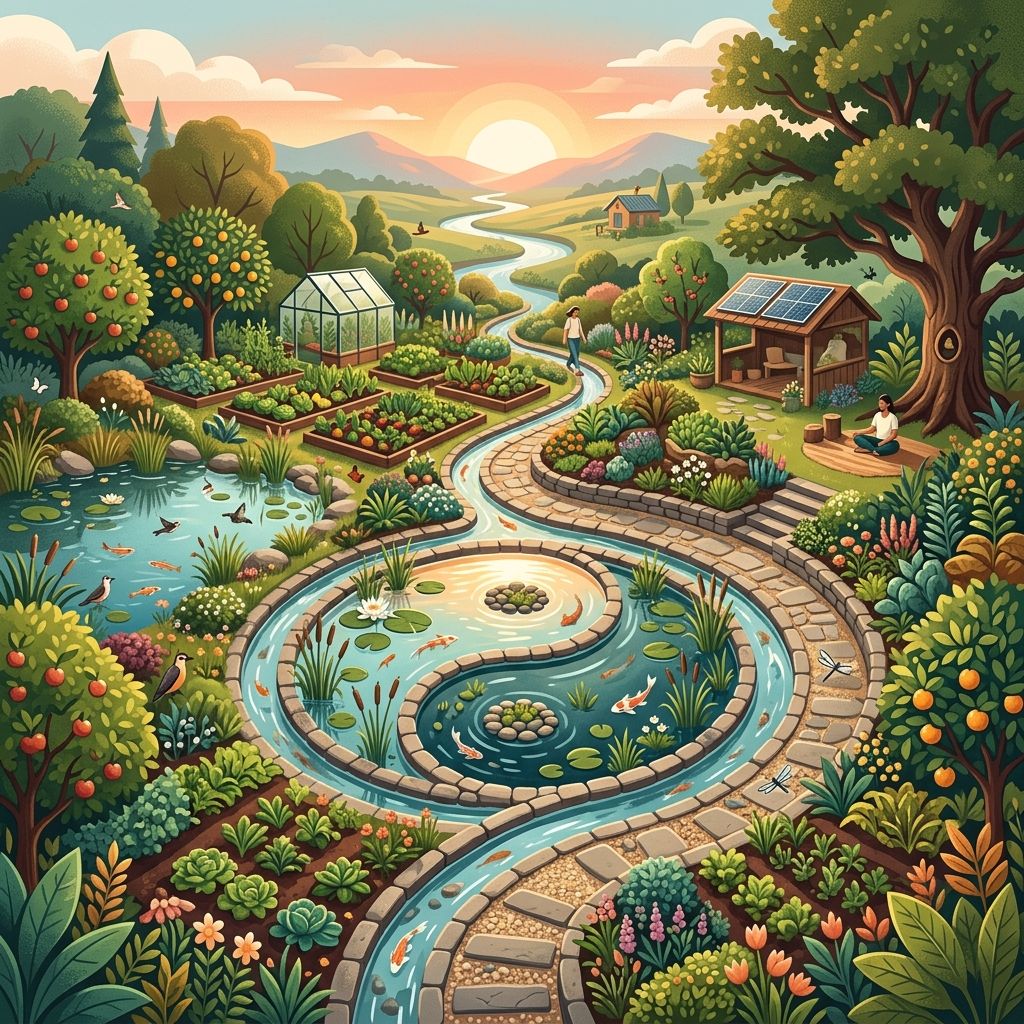
Imagine you are on an isolated cliff edge, owning a completely self-sufficient cabin that provides you with everything you need to survive. If someone offered you one million US dollars to exchange for this ticket to move in, would you trade it?
Today, with extreme climate, economic instability, and food crisis looming, true security may no longer be a number in a bank passbook, but an ecological code that integrates ancient survival wisdom and modern system science, namely "Permaculture".
This "Doomsday Ticket" proposed by Western scientists 50 years ago, at the end of its philosophy, perfectly aligns with our familiar ancient Daoist thought! Laozi more than two thousand years ago had already been quietly sitting at the finish line, giving us the most calm survival answer.
Why is Nature Actually a Ruthless Tyrant?
Modern urbanites often hold a romantic fantasy about "returning to nature," assuming that what is purely natural is safest and kindest.
But in fact, undesigned raw nature is often ruthless and cruel.
| Ecological Mode | Survival Status | System Characteristics |
|---|---|---|
| Pure Nature Undesigned (e.g., Dariya Boyi Oasis) |
At the Mercy of Heaven Once the river shifts course, the oasis instantly turns into dry bones |
Fate is completely hijacked by a single natural factor |
| Man-made Design Support System (e.g., Japan’s Masue Village Satoyama) |
Sustainable Symbiosis Humans, fish, and rice fields circulate and cooperate |
Becoming an active partner of nature |
As Laozi said in the 《Dao De Jing》:
"Heaven and earth are not humane, they regard all things as straw dogs."
Purely natural ecological succession often ignores human survival.
Taking Dariya Boyi in the heart of the Taklamakan Desert as an example, the residents live near the water in the center of the desert, seemingly living a paradise-like life. However, their fate is completely hijacked by the Keriya River. Once the river shifts course due to climate change, their home, which was once lush with water and grass, will instantly turn into dry bones and windblown sand.
This is also why Permaculture emphasizes:
True sustainability does not lie in nature itself, but in the man-designed system.
We must use systematic scientific thinking to add an ingenious artificial support system to the natural paradise, actively building a cooperative framework to successfully transform ourselves from victims of nature into partners of nature.
Core Concepts of Permaculture and "Wu-Wei"
This system, known as "Permaculture," is combined from "Permanent" and "Agriculture."
Founder Bill Mollison discovered a huge blind spot in modern agriculture 50 years ago:
To grow crops, people constantly weed, fertilize, and irrigate, trapping themselves in endless adversarial toil, but in return only getting increasingly degraded and barren land.
But he turned to observe primary forests, only to discover a truth that puts modern people to shame:
Primary forests never weed or fertilize, yet they can run self-sufficiently and vibrantly for hundreds of millions of years.
Mollison realized that humans had been blindly trying to "conquer" nature, forgetting to "mimic" nature’s autopilot mode.
The core logic of Permaculture lies in "Observation over labor", which means:
Stop working like a slave; observe how nature "slacks off" and follow suit!
This is exactly the same as the core of Daoism, Wu-Wei (doing nothing).
"Wu-Wei" does not mean doing absolutely nothing, but rather aligning with the essence and general trend of all things, reducing ineffective energy confrontation, and letting the ecosystem manage itself, returning to an efficient autopilot state.
How Satoyama Wisdom Lets Fish Help Wash Dishes?
In Masue Village in Harie, by the shores of Lake Biwa in Japan, local villagers preserve a survival technique called Satoyama Wisdom, perfectly demonstrating how to elegantly "coexist through Wu-Wei" with nature.
They use a household spring water system called Kabata to achieve an exquisite cycle of humans, water, and fish:
| Pond Division | Operating Function | Metaphor in Life |
|---|---|---|
| First Pond | Used for cooling vegetables/fruits, drinking, and gathering water | Clean water dispenser |
| Second Pond | Used for washing tableware with food residues and oil stains | Automatic dishwasher |
In this system, the most ingenious design is the carp swimming in the second pond. When tableware is placed in the pond, the fish will actively swim over to eat the food waste and grease on them.
The fish convert food waste into protein in their bodies, and the dishes also become clean as a result.
And the fish manure they excrete flows through a two-kilometer-long artificial water channel to the rice fields, becoming the best organic nutrients for rice and reed growth.
The flourishing reeds in turn provide a natural hatchery and refuge for spawning fish returning to the area.
This system perfectly practices the Permaculture principle of "Produce no waste", which means:
Every part regarded as waste in the system becomes high-grade food for the next life.
How to Turn Crawfish from Pests into Chicken Feed?
In Permaculture Design, there is a core mindset that subverts convention: Integrate rather than segregate.
Pests and troubles are actually just misplaced resources.
The owner of a farm in the deep mountains of Chongqing, Huang Jinxing, once faced the nightmare of all chicken farmers: the chickens lacked protein and calcium, laying a large number of fragile "soft-shelled eggs".
The traditional direct confrontation thinking is to spend a lot of money buying external calcium tablets and feed, which easily mold and spoil in Chongqing’s humid weather, causing chickens to get sick.
However, Farmer Huang instinctively applied the integration logic of Permaculture:
| Method | Description |
|---|---|
| Discovering Trouble | The farm pond was currently swarming with a large number of crawfish and trash fish that destroyed crops and nobody wanted to eat. |
| Transforming Expense | He gathered and crushed these rampant crawfish, making a "seafood feast" to feed back to the calcium-deficient chickens. |
| Unlocking Ecological Chain | After eating the high-protein, high-calcium crawfish, the chickens laid eggshells as hard as stone with excellent quality, greatly increasing the unit price; the pests in the pond were cleaned up, the water became clean, and he also took the opportunity to cultivate loaches and crawfish in symbiosis, which fed on each other’s excrement, forming an excellent three-way cycle. |
Not only that, Farmer Huang also planted highly fertilizer-loving fig trees in the forest to absorb the accumulated chicken manure.
In the chicken coop, he laid rice husks and wood chips to make a fermentation bed, using beneficial bacteria to decompose accumulated manure to solve odor and high temperature, and used the replaced fermented material to raise earthworms.
After these earthworms reproduced, they were thrown back into the pond to feed crawfish and loaches.
This is a grand ecological design that spans the four seasons! The originally headache-inducing manure and pests, under ingenious configuration, all turned into an endless wealth closed loop.
Shang-Shan-Ruo-Shui: The Slow Water Philosophy of Transforming Crisis
Facing heavy rain and floods, traditional engineering logic is to build tall, hard seawalls or concrete walls for direct confrontation, which often results in more severe erosion.
But Permaculture Design teaches us to learn to play Tai Chi with water, practicing the "slow water philosophy" of Shang-Shan-Ruo-Shui (highest good like water):
| Method | Description |
|---|---|
| Swales | Along the contour lines, carve out smiling curve ecological ditches on the land. When heavy rains and mountain torrents come, the water flow will not run off and cause soil erosion, but will be intercepted by the ditch system, letting the water slow down, sink in, and spread out, transforming into precious groundwater resources. |
| Banana Circles | Dig a deep pit in the center to pile food waste and wastewater, and plant highly water-loving and fertilizer-loving banana trees on the outer ring. While absorbing water and growing rapidly, the banana trees also form a micro windbreak to protect other tender plants in the circle. |
This echoes what Laozi said: "The highest good is like water. Water is good at benefiting all things without striving, and occupies places that people dislike, so it is close to the Dao."
Gently neutralizing destructive forces into sweet dew that nourishes the earth.
Ecological Hackers in Cities and Modern Technology
You might ask, if I live in a city without a farm, can I also use Permaculture?
Permaculture never represents returning to the primitive, but is a set of bio-hacking techniques that make good use of natural laws and modern technology. Even in an apartment or office, you can create high yields through precise edge systems:
| Method | Description |
|---|---|
| Aquaponics | Using microorganisms to convert fish waste (ammonia nitrogen) into the nitrogen fertilizer that vegetables love most, and the vegetables purify the water before it flows back into the fish pond. This technology allows you to raise fish without changing water, and grow vegetables without fertilizing, with yields dozens of times that of traditional agriculture. |
| Herb Spiral | Using vertical structures to create microclimates, making ultimate use of the Edge Effect. In a space with a diameter of only two meters, the topmost layer is a dry zone for planting dry-loving rosemary; the bottommost layer is a wet zone close to a small pond for planting water-loving mint, yielding up to three times that of flat land. |
| Black Soldier Fly Bioconversion | On the factory side, introducing black soldier fly larvae to treat hundreds of tons of smelly chicken manure. The black soldier flies can swallow the manure clean within a few days, precisely converting it into high-protein insect bodies (premium feed for chickens and fish) and dry, odorless organic fertilizer, completely achieving zero emission. |
The Most Core Ecology is Our Inner Self
In the planning of Permaculture Design, scientists divide the environment from the inside out into Zone 1 (frequent activity zone) to Zone 5 (wilderness).
But after experiencing countless ecological designs, scientists turned back to discover that the most core and important part of the entire system is actually Zone 0, which is our human mind and way of thinking.
This is a practice akin to "mindset transformation." When you internalize Permaculture’s systemic thinking, your view of life challenges and anxiety will completely change:
| Transformation | Description |
|---|---|
| Facing Failure and Setbacks | You no longer feel sorry for yourself, but regard them as inevitable "organic waste" in the life system, transforming them into "organic compost" to nourish the next success and flowering. |
| Facing Trouble and Crisis | You no longer fight head-on, but observe hidden resources around you and reconfigure them, converting expenses into outputs. |
The true paradise is never "found" geographically, but is "planted" in the present with your inner thinking.
In this AI era filled with information explosion, climate turmoil, and anxiety, as long as your heart (Zone 0) builds this energy cycle that conforms to nature and is endless, no matter how the outside wind and rain collapse, you have already grasped that "Doomsday Ticket" to calmly deal with the future.