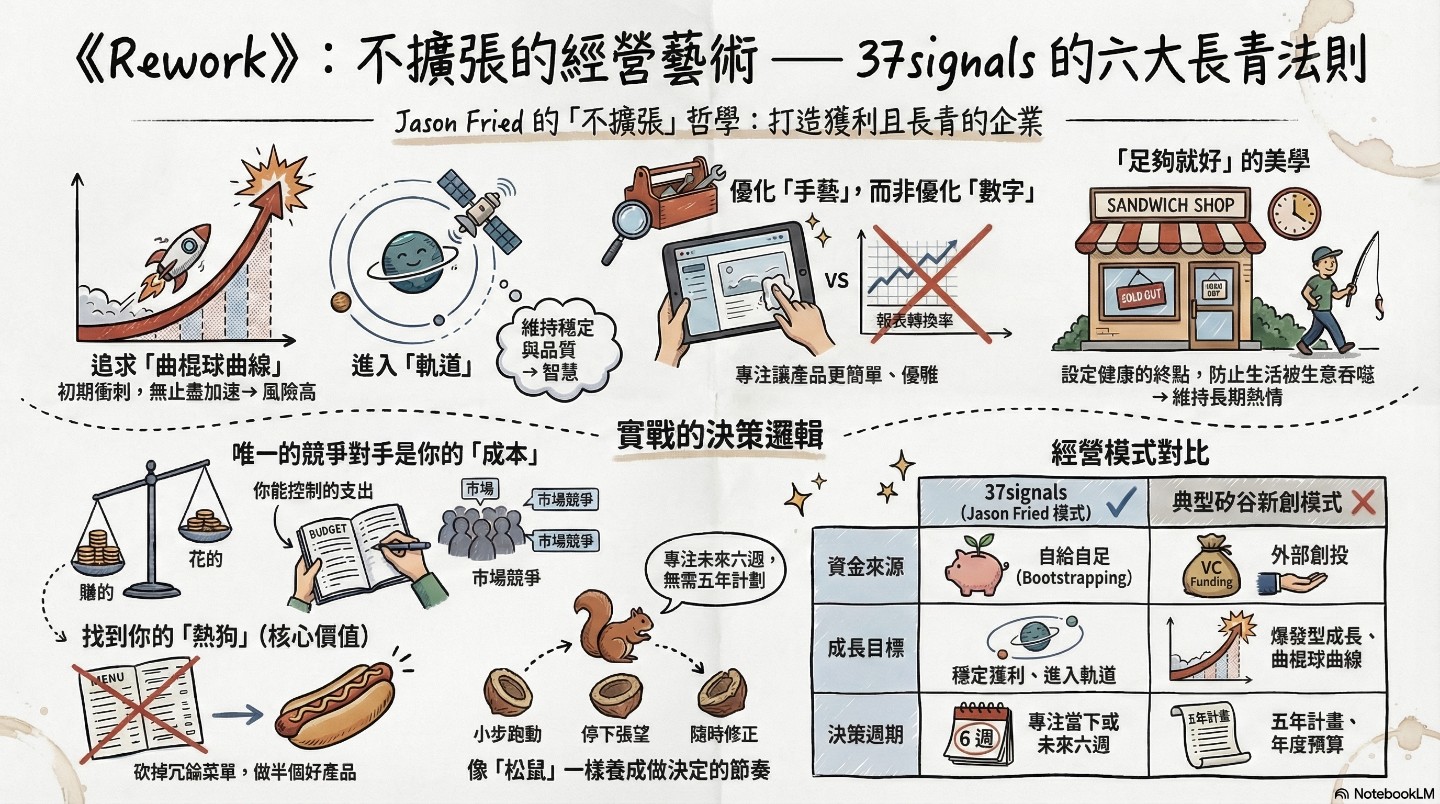
Do you ever get the feeling that society is constantly telling us to be “bigger, more, and better”? Whether it’s running a company or building a personal brand, everyone seems trapped on that “hockey stick curve” that demands straight-up takeoff—like a treadmill accelerating infinitely until we’re exhausted.
But what if you chose to stop at a place that was “already good enough”?
This is the “non-expansion” strategy advocated by 37signals founder Jason Fried. This isn’t just about making money; it’s about how to take back control of your life.
1. Find Your Comfortable Orbit, Don’t Be Fooled by the “Hockey Stick Curve”
The narrative Silicon Valley is most obsessed with is the “hockey stick curve,” which starts flat and then erupts vertically. For Jason Fried
This is not growth, but a loss of control.
He compares entrepreneurship to “launching a rocket”:
| Stage | Description |
|---|---|
| Breaking Gravity Stage | The early days of a startup do require burning massive energy to break through the pressures of survival and costs. |
| Entering Orbit Stage | Once you make more than you spend, you’ve entered “orbit.” |
In orbit, “maintaining quality” is far more important than blind acceleration.
If your company gets twice as big, but loses the very qualities that made it wonderful in the first place, so what?
2. Optimize the “Craft,” That’s Your Pride in the Work
Jason Fried opposes what he calls “boring optimization.” Simply A/B testing like crazy to improve conversion rates by a fraction of a percent or fine-tuning button colors is, to him, boring beyond belief!
What he advocates instead is “interesting optimization”: focusing on making the product easier to use, simpler, and more elegant. The operating metric shouldn’t be the numbers on a spreadsheet, but rather
“When I wake up tomorrow, do I still want to do the exact same thing again?”
When you are proud of your work, the product will naturally generate its own attraction.
3. Your Only Competitor Is Your “Cost”
Fixating on competitors will only result in building copycat products. In contrast, Jason Fried believes the core of business is exceedingly simple:
As long as you make more than you spend, you survive.
He emphasizes the need for “The Blubber”: a company shouldn’t run so lean it’s bone-thin, but should maintain a financial buffer.
This layer of “blubber” kept them completely safe during the financial crisis and the pandemic.
“We take risks, but we never put ourselves in jeopardy.”
4. The Aesthetic of “Just Enough”: The Wisdom of Closing When Sold Out
This is a beautiful concept. There is a sandwich shop in Chicago that uses fresh bread daily and closes its doors the moment it sells out (usually by 2:30 PM). The owner refuses to use day-old bread just to make a little extra money, because
“It’s not worth selling food that you aren’t proud of.”
This aesthetic of “just enough” allows operators to find a long-term balance between their profession and their life, preventing business from swallowing up their entire existence.
5. Focus on the Core “Hot Dog,” Leverage the “Byproducts”
If you remove a certain feature and your product ceases to exist, then that is your “hot dog.”
| Method | Description |
|---|---|
| Subtract First | Resource constraints can actually be an advantage that forces creativity. It’s better to build half a great product than a half-baked complete one. |
| Leverage Byproducts | The “leftovers” generated while polishing your core product can also be translated into value. Just as 37signals compiled their management experiences into the book “Rework,” or turned leftover materials into a compelling free newsletter. |
6. Make Decisions Like a Squirrel Crossing a Lawn
“Planning is guessing”
When you are making long-term plans, it’s often the exact moment you have the least information.
Rather than falling into “analysis paralysis” over a grand plan, it’s better to act like a squirrel crossing a lawn:
Run a distance, stop to observe, correct your course, and run again.
Break progress down into small decisions measured in “days.” If you run in the wrong direction, your losses are limited strictly to that single day, which keeps you motivated to keep pushing forward.
Conclusion: Regaining Control Is the Ultimate Success
Abandon the blind worship of that “hockey stick curve” and spend your energy taking back control of your business and life.
If your work makes you feel that “if I stopped, the world would miss it,” and every single day you still have the motivation to keep running, then that is the ultimate success.
You don’t necessarily have to change the world; as long as you make your customers feel their lives are a little better, that is incredibly meaningful.