Do you ever feel like you are working very hard, but when faced with a problem, you tend to “just do what others are doing”, ending up totally exhausted and only earning a hard-earned pittance?
This is actually because our brains, in an effort to save energy, unconsciously fall into the traps of analogy thinking and herd mentality.
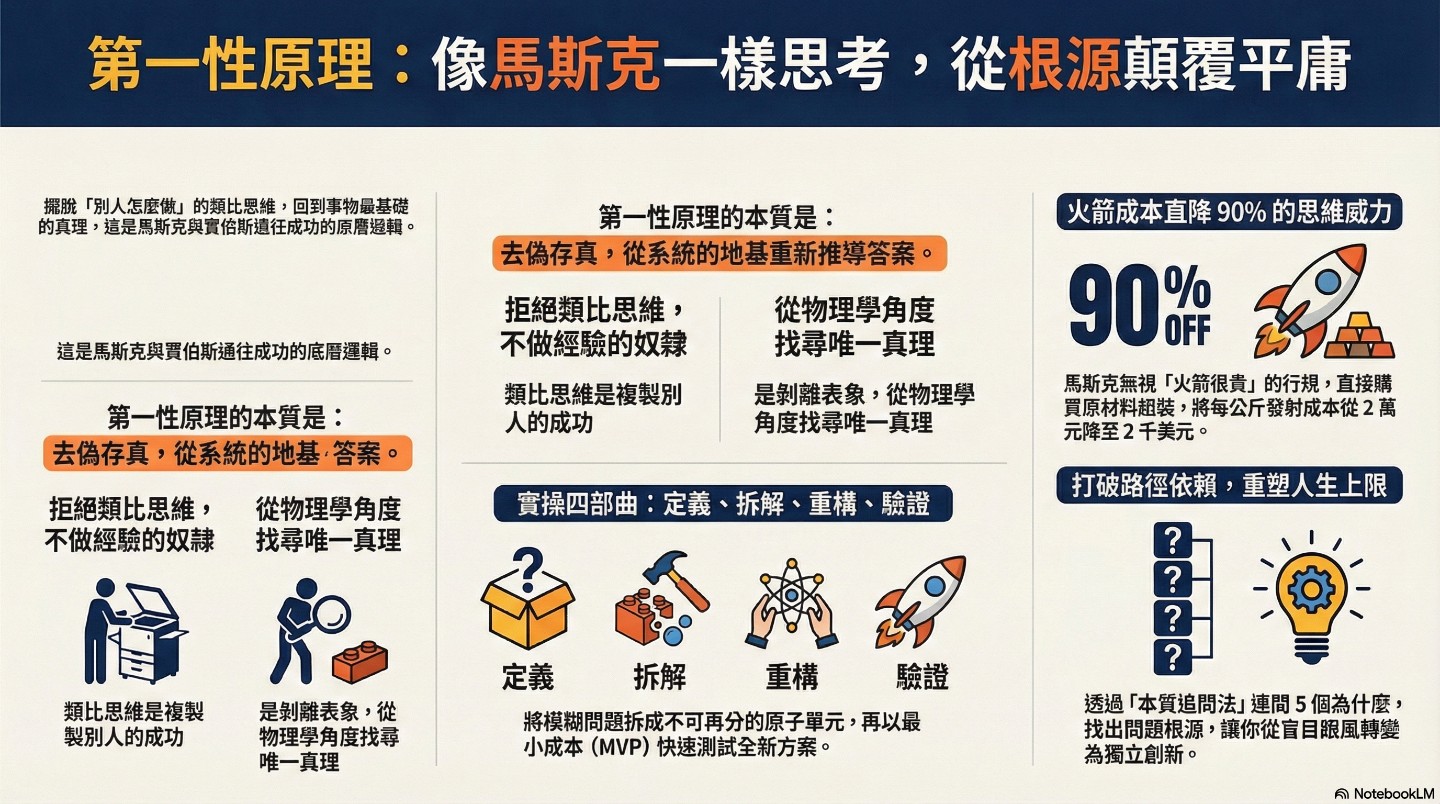
However, First Principles rethinking is a mental artifact that can help you solve fundamental problems and even disrupt convention entirely.
What are First Principles? It’s Actually the Fundamental Logic of Physics
First Principles Thinking is simply:
“Getting to the bottom of things by breaking them down into the most basic, absolute objective facts, and then rebuilding from scratch.”
When we solve problems, our brains usually try to conserve energy by employing analogy thinking.
We look at what others are doing and follow suit, perhaps tweaking it slightly. In short, “copying with minor adjustments.”
First principles thinking, on the other hand, ignores what others are doing or what past experiences suggest, focusing only on: “What are the most fundamental conditions of this matter based on physics or its profound true nature?”
Breaking the Myth of Analogy Thinking
In simple terms, it’s about peeling a complex problem like an onion down to its most basic, absolutely objective facts, and then deriving a solution anew from this foundation. This is entirely different from the habit of blindly following trends!
Real-World Applications by Top Visionaries: Musk and Jobs
For example, Elon Musk founding SpaceX is the most classic case. Initially, he wanted to buy rockets, but the prices quoted by the Russians were too high. He used first principles to break it down:
“What is a rocket fundamentally made of? Aluminum alloys, titanium, carbon fiber. What is the market value of these raw materials?”
After calculating, he realized the raw material costs accounted for only a mere 2% of the total rocket manufacturing cost! The remaining 98% was entirely premium brought about by inefficient manufacturing processes in the traditional aerospace industry.
Since the fact was “the raw materials are very cheap,” he decided to buy the materials and build the rockets himself, brutally slashing the costs down to a fraction of the original price.
Steve Jobs did the same. Phones back then all had a bunch of physical buttons, but instead of asking “how to make a button phone easier to use,” he explored “what is the true nature of a mobile communication device,” which led to the redefinition of the iPhone.
A Four-Step Breakdown Method Even Ordinary People Can Use
This method isn’t just for building rockets; it can also be used for career advancement and personal finance!
| Step | Brief | Description |
|---|---|---|
| 1. Define the Problem | List your “of courses” | Write down all the assumptions you believe are “just the way things are” or “what everyone says is the only way.” |
| 2. Deconstruct the Problem | Find the basic facts | Like an annoying five-year-old, keep asking “why” until you hit “objective facts.” This is known as the 5 Whys root cause analysis. |
| 3. Reconstruct Solutions | Innovative combination | Use the remaining “fundamental building blocks” to break out of the original framework and piece together a new solution. Don’t patch old methods; create new rules directly. |
| 4. Validate and Iterate | Pragmatic testing | Build an MVP (Minimum Viable Product) with the lowest cost and test it in the real world to see if your new logic holds up. |
First Principles Thinking Flowchart
  graph TD
    A[Encounter a bottleneck or high-cost status quo] --> B(Phase 1: Eradicate inertia<br>List all assumed 'of courses' and 'conventional methods')

    B --> C{Phase 2: Soul-searching question<br>Is this assumption an indisputable<br>objective fact?<br>E.g., laws of physics, mathematics}

    C -- "No (Just experience, blind conformity, or an excuse)" --> D[Use the 5 Whys to continuously ask 'why']
    D --> C

    C -- "Yes (An unshakeable absolute fact)" --> E[Extract and retain as 'fundamental building blocks']

    E --> F(Phase 3: Lego restructuring<br>Break old frameworks and reconstruct from scratch using basic blocks)

    F --> G[Phase 4: Cost reduction and efficiency<br>Design the lowest-cost MVP for field testing]

    G --> H{Did the test successfully achieve the goal?}

    H -- "No (Discovered new variables or wrong assumptions)" --> B
    H -- "Yes (Path successfully validated)" --> I(((Acquire an innovative and pragmatic solution)))
Why Is It So Powerful Yet Rarely Used?
Because it consumes a tremendous amount of mental “vital energy”!
We are inherently wired to be lazy, making it very easy to fall back on old experiences. However, by practicing just 10 minutes a day—like asking “why” 5 consecutive times when facing a problem or deliberately making an “anti-commonsense” small decision—you can gradually train this mental muscle that belongs to the strong.
Put plainly, first principles teach us this: Whether you want to create value in your career or achieve steady returns in investing, breaking out of the safe framework of “everyone does it this way” and boldly returning to the essence is the key to escaping mediocrity.
Next time you feel lost, try asking yourself:
“If everything could be restarted without any limitations of experience, what should be my very first step to achieve my goal?”