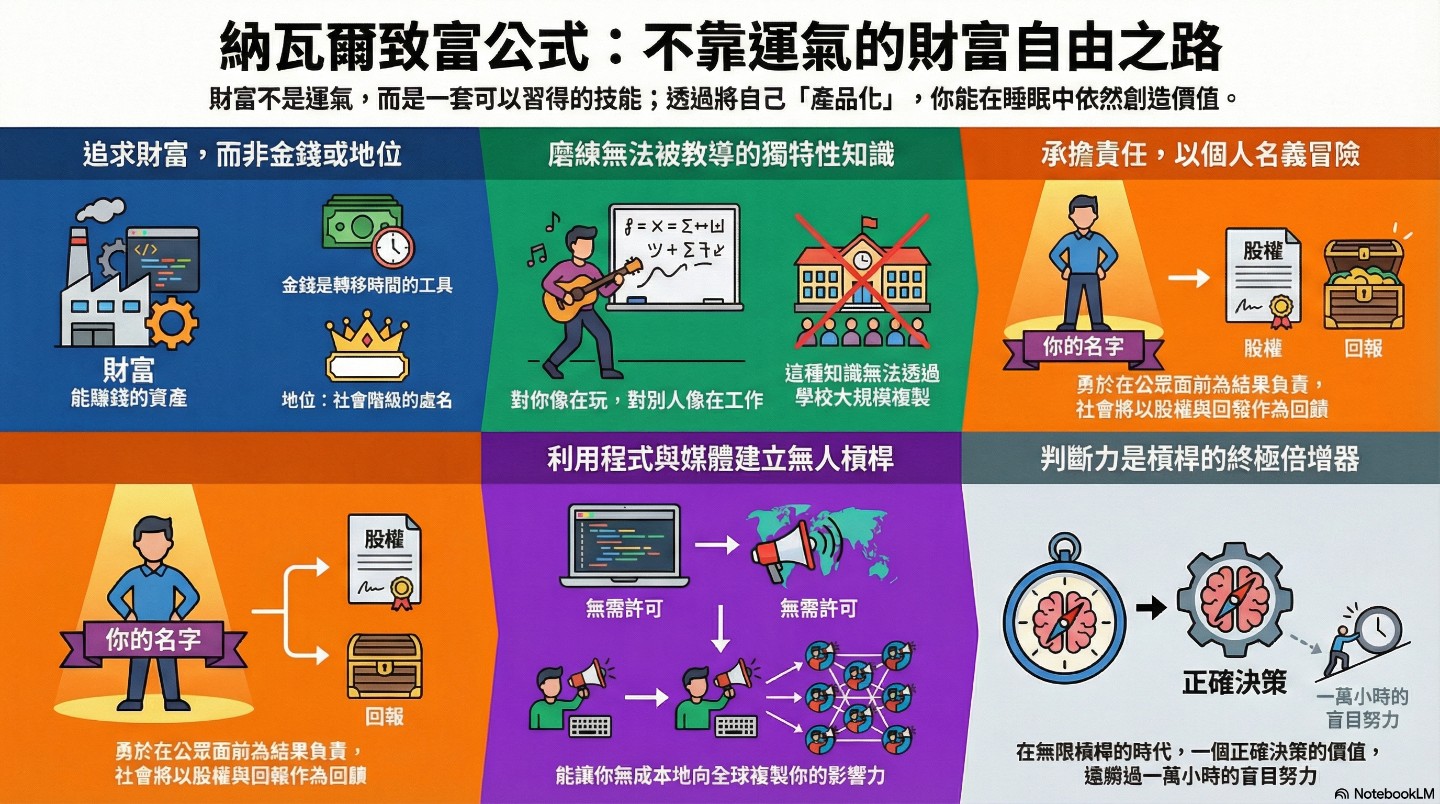
Can you distinguish between “wealth”, “money”, and “status”? Many people think being rich means having a lot of cash or driving a luxury car to show off their status, but these are actually completely different concepts.
If you aspire to genuine financial freedom, no longer wanting to be awakened by an alarm clock every morning or squandering your life on a commute, then you must explore Silicon Valley legendary investor Naval Ravikant’s “algorithm for wealth”.
Getting rich is not about luck; it is a skill that can be learned!
The Four Pillars of Wealth: Building Your Own “System”
So why does Naval say getting rich can be independent of luck? In short, it is about building a “system” of your own.
1. Specific Knowledge
Specific knowledge is not what is taught in schools; things learned by rote can easily be replaced by AI or other people.
Specific knowledge is your innate curiosity and passion
Naval gave an example: for him, reading about science and microeconomics is his specific knowledge.
| Practical Case | Description |
|---|---|
| Treating work like play | Think about something where others think you are working hard, but you feel like you are playing? It could be exceptional sales skills, an obsession with an obscure technology, or a mastery of human psychology. |
| Selling and Building | “Learn to sell, learn to build. If you can do both, you will be unstoppable.” This is the best manifestation of specific knowledge. |
2. Leverage
Without leverage, you can only ever use “one unit of time in exchange for one unit of money”, which has a limit.
“Time is limited, so the money you can exchange for it is also limited.”
There are three types of leverage:
| Type of Leverage | Description | Pros and Cons |
|---|---|---|
| Labor Leverage | Having others work for you | This is the oldest form of leverage, but managing humans is very troublesome, and it is a zero-sum game for status. |
| Capital Leverage | Making money with money (Investing) | It has created many billionaires, but the downside is “it requires others’ permission”—others must be willing to give you their money. |
| Code and Media | The newest type, products with zero marginal cost of reproduction | This is the secret weapon of the new rich! A piece of code you write or a Podcast you record are all a “robot army working for you.” The best part is it does not require permission to create. |
3. Accountability
In the commercial world, there are no outsized returns without taking risks.
You must bravely take risks under “your own real name”.
Just like a real estate developer buying wasteland under their own name, bearing the risk of failure; once successful, society will reward them with “equity” and capital.
You are the captain of this ship, bearing the risk of sinking, but also monopolizing the glory of reaching the treasure island.
4. Judgment
When you possess massive leverage (like large amounts of capital or millions of subscribers), a single decision of yours will be amplified countless times.
The amount of effort put in is no longer important; what matters is “whether the direction is right.”
Just like steering a giant ship, even a 1-degree deviation will lead you thousands of miles off course over time.
Warren Buffett doesn’t need to work 16 hours a day; by relying on his highly accurate “judgment” combined with “capital leverage,” he can create astonishing wealth.
Can Luck Be “Designed”? Productize Yourself
Some people might say: “These sound very reasonable, but aren’t all those rich people just lucky?”
Naval put forward a perspective: Luck can be designed. He categorizes luck into four levels:
| Type of Luck | Description |
|---|---|
| Blind Luck | Pure chance, like a blind cat finding a dead mouse (e.g., winning the lottery). |
| Luck from Hustling | Taking the initiative and scurrying around to increase your chances of stumbling upon something. |
| Prepared Luck | A sensitive radar. When an opportunity flashes by and others miss it, you recognize it at a glance. |
| Attracted Luck | The highest level! When you maximize your “specific knowledge,” “accountability,” and “leverage,” building a personal brand, luck will actively seek you out. |
Take a classic example: imagine you are the world’s premier deep-sea diving expert. One day, a treasure hunter finds a sunken ship full of gold in the deep sea but cannot retrieve it. At that moment, he has no choice but to bring the profits to you. You did nothing but polish your unique skills to the extreme, and someone else’s good luck automatically became yours.
This is Naval’s most famous quote:
“Productize Yourself”.
"Yourself" represents uniqueness with accountability, and "Productize" represents the use of leverage.
People in Silicon Valley are willing to help each other because they know this is a long-term game.
All returns in wealth, relationships, and trust come from compound interest.
Find Your Positive-Sum Game
What is the ultimate goal of pursuing wealth? It is actually “freedom.”
Money solves money problems, giving you the leeway to pursue those priceless treasures that money cannot buy:
- A peaceful mind
- A healthy body
- A home filled with love
Starting today, stop playing the linear game of trading time for money. Try to find your specific knowledge, equip yourself with leverage, and kick off your positive-sum game of wealth!