
Why has a gaming term “Kill Line” caused a collective breakdown in American society?
In games, if your HP falls below a certain threshold, the Boss activates a “Kill” skill, instantly executing you. We used to use "bankruptcy" to describe financial crisis, but that often carries a hint of "poor personal management"; however, the viral term "U.S. Kill Line" reveals a crueler social reality
It’s not your personal failure, but a systemic class harvest.
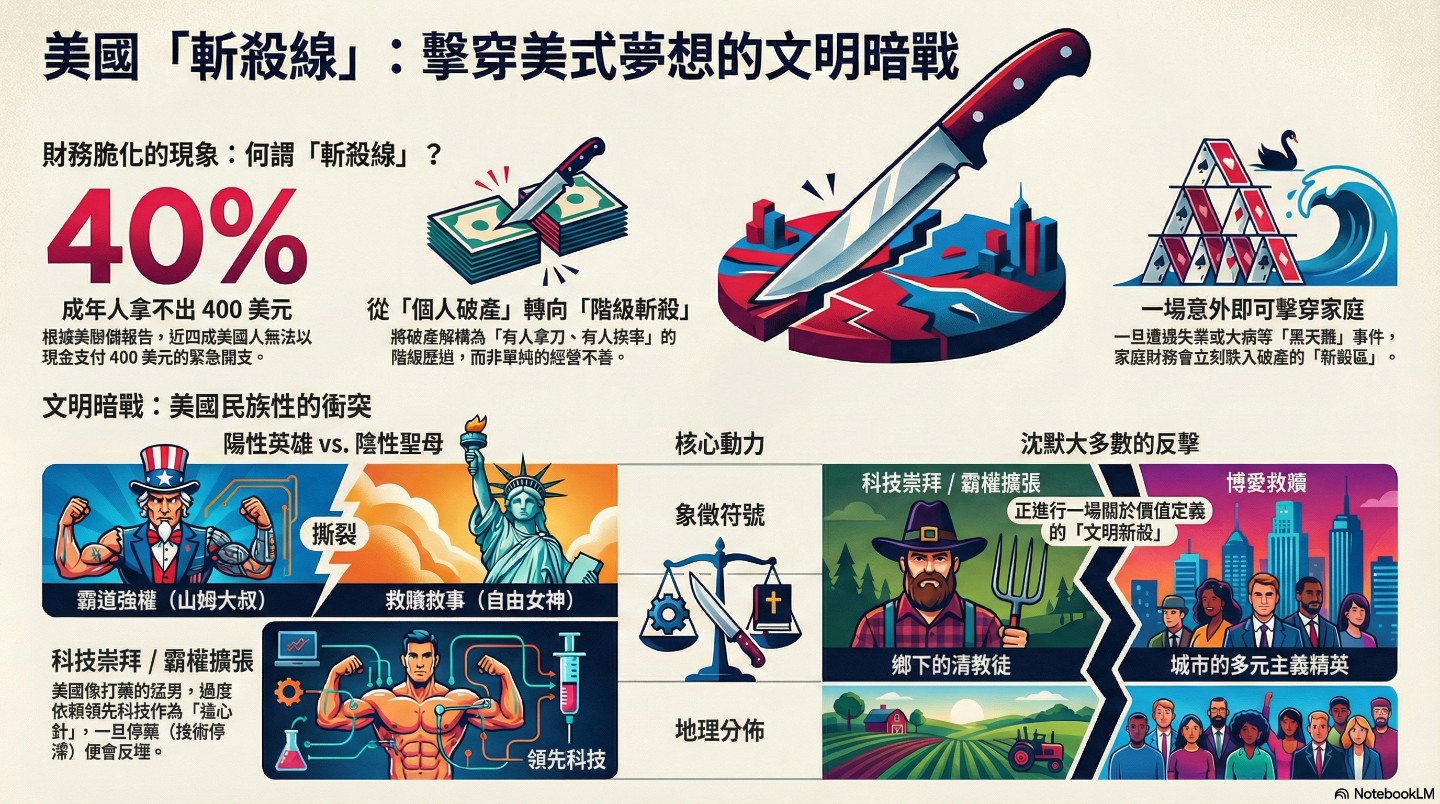
When 40% of Americans cannot come up with $400 for an emergency, this isn’t just poverty; it’s an extreme fragility where one can be “instakilled” by the system at any moment.
The $400 Fig Leaf Lifted: What is the ALICE Line?
To put it bluntly, this term uncovers two unspoken secrets of America. First, we must understand a data indicator: ALICE (Asset Limited, Income Constrained, Employed).
Simply put, these people are “asset limited, income constrained, but employed.” They are not homeless wanderers; they might even be your hardworking blue-collar neighbor or a fresh graduate. Although their income is above the poverty line, it is insufficient to cover basic living expenses.
In this state, any sudden accident, whether it’s a car breakdown, a minor illness, or brief unemployment, becomes the key to triggering the ‘Kill’. For them, life is like walking a tightrope with only 1% HP left, and that $400 emergency fund is their last fig leaf.
From “Personal Failure” to “Class Enemy”
Why does the term “Kill Line” resonate so hugely in the US? Because it completely shatters the traditional narrative of the “American Dream”. The old logic was:
If you are poor, it’s because you didn’t work hard enough
But the concept of “Kill Line” shifts the perspective to the “Harvester”. This means it’s not that you can survive if you work hard, but that the system is designed to instantly kill you when your HP gets low. This narrative transforms economic issues into a form of class confrontation
What you face is not fate, but a class enemy holding a knife, waiting for the moment
The Anxiety of the “Steroid-Pumped Macho” and the Puritan Counterattack
But if you only see economic issues, you underestimate this storm. This is actually a “Civil War of Civilization” for the American soul.
The current US is like a “steroid-pumped macho man” maintaining muscle with technology (steroids). Outwardly tough, possessing Musk-style technology cults and powerful hegemony, but inwardly lacking the tempering of historical depth. This “Yang Hegemony,” although powerful, is constantly in extreme anxiety of “stopping the meds” (losing technological advantage).
On the other end are the “Silent Majority” suffocated by the abstract dictatorship of “multiculturalism”—the traditional upholders of Puritan ethics. They seek redemption, believe in sweat, yet are marginalized in the modern system.
The emergence of Trump is exactly the counterattack of this “Yin/Traditional” force against the “Yang/Hegemonic” system. This is not a pure political struggle, but the America that originally “sought redemption” trying to kill, on the Kill Line, the alienated America that is currently “addicted to conquest.”
Conclusion: The Kill Line is a Fracture in Civilization
So, the Kill Line is not just an economic red line; it is a fracture in civilization.
When we discuss that $400, we are looking not just at Americans’ wallets, but at their tearing national soul. As “Tech Oligarchs” and “Traditional Rednecks” engage in hand-to-hand combat on the Kill Line, we might be witnessing the labor pains of an empire’s transition.
In the end, that red line is not just a boundary of wealth, but the deepest fear and resistance of people regarding the act of “living.”