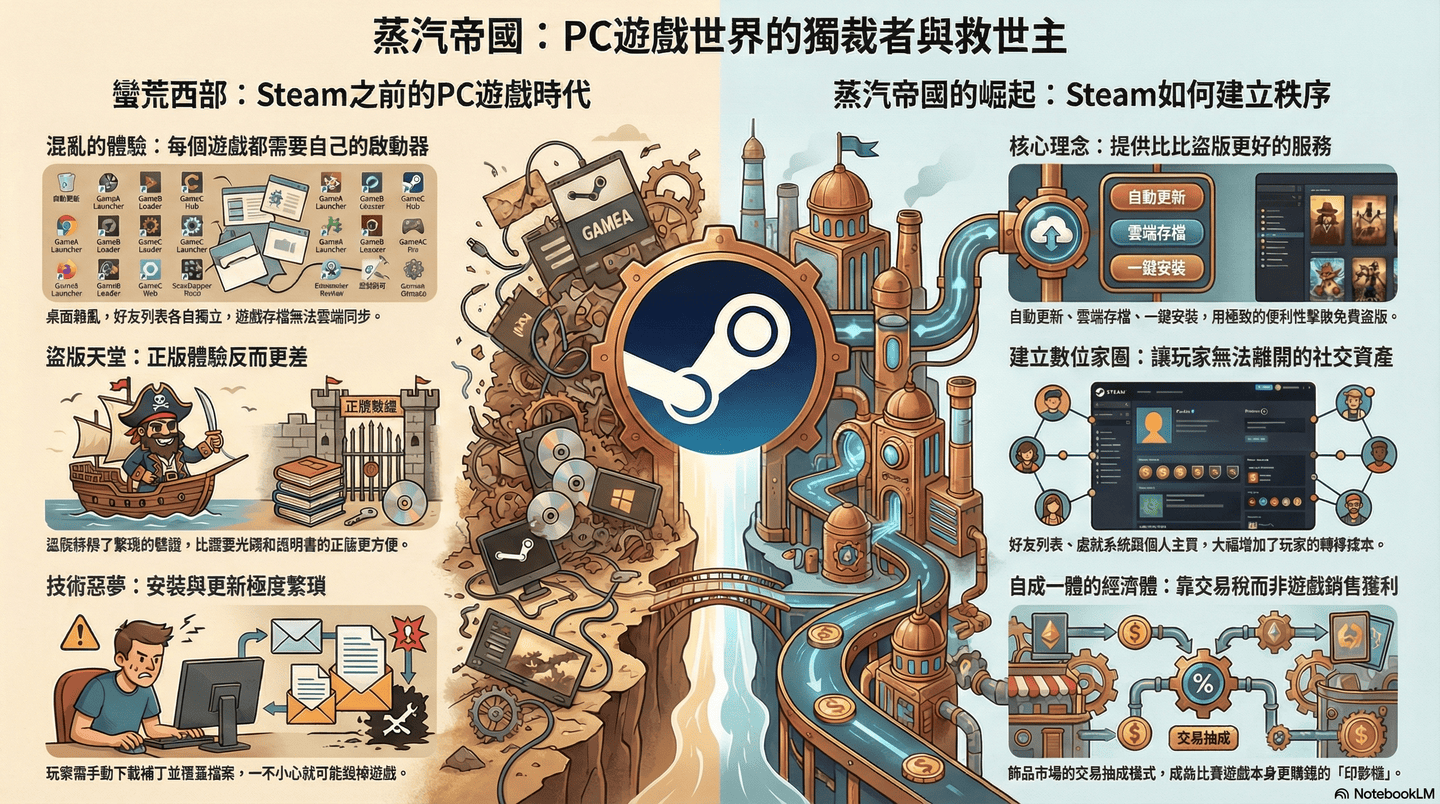

Imagine if, until today, that familiar blue steam icon had never appeared on our computer screens—what kind of life would PC gamers in 2026 be leading?
You might find your desktop cluttered with dozens of different launchers, each with its own independent friend list and save system. Switching computers would be like a major migration, where hundreds of hours of hard work could vanish at any moment. And all of this is just the tip of the iceberg of that “Stone Age.”
Today, let’s talk about how Steam, which was originally criticized by players as “bloatware,” step-by-step built a digital empire that rules the world, and why the world under this “dictated” rule seems so “beautiful.”
Truth 1: The Cure for Piracy is Service, Not Law
Valve’s founder, Gabe Newell (also known as Lord Gaben, loved and hated by many), proposed an insight in 2011 that laid the foundation for the empire:
“Piracy is almost always a service problem and not a pricing problem.”
He observed that at the time in Russia (once a piracy haven), legitimate games would take months to hit the market and were usually only available in English. Meanwhile, pirates provided cracked versions on day one, even thoughtfully including translations that weren’t great but were understandable.
As a player, why would you spend more money to buy a product that is released later, has a worse experience, and is in a language you don’t understand?
So Steam’s strategy was simple: Provide a service that is more convenient and enjoyable than piracy.
It’s like building a tap water system. Piracy is like free but dangerous river water; you have to walk a long way to get it and worry about bacteria (viruses). Steam’s tap water system costs a fee, but as soon as you turn the tap (one-click purchase and download), you have clean water (automatic updates, cloud saves). When the water fee is cheap enough and extremely convenient, no one wants to risk going to the river to get water anymore.
Truth 2: Was the Empire’s “Coronation” Actually a Forced Gamble?
Many don’t remember that when Steam launched in 2003, players had only one word for it: Terrible.
An eerie olive-green interface, snail-like download speeds, and frequently crashing servers. At the time, players even parodied its logo as a pile of spinning poop. To save this “unwanted freak,” Valve made the most insane gamble in PC gaming history: mandatory binding with Half-Life 2.
In 2004, fans worldwide who were eagerly awaiting this masterpiece found that even if they bought the physical disc, they couldn’t play it unless they installed the “bloatware” Steam and activated it online.
Angry letters flooded Valve’s office, but Lord Gaben, like a cold-blooded dictator, forced this “medicine” down the throats of millions of players. As the game quality amazed everyone, players had to compromise. At that moment, the nomads on the wasteland began to have a unified “digital identity card.”
Truth 3: Irreplaceable “Digital Real Estate” is the Strongest Moat
Lord Gaben knew well that just having a shop wasn’t enough; he wanted to lock players into a “home they can’t move away from.”
When you’ve invested ten years in Steam, with “awards” for suffering 200 hours in Elden Ring hanging on the wall, a friend list full of old neighbors in this community, and a profile page beautifully decorated, it becomes your “Digital Real Estate.”
| Situation | Traditional PC Gaming Experience | Steam Platform Experience |
|---|---|---|
| Buying Games | Searching for discs and forum crack patches everywhere | One-click purchase, automatic download and installation |
| Saving Data | Manually backing up saves, lost when changing PCs | Cloud saves, seamless progress transition |
| Buying Bad Games | Just bad luck | No-questions-asked refund within 2 hours |
| Scattered Friends | Scattered across various clients | Unified social and achievement system |
This is why even when competitors (like Epic) give away free games every week, players usually just “grab the key and stay for a night,” ultimately returning to Steam. Because social relationships and memories cannot be taken away.
Truth 4: The Game Store is Just the Skin; The Core is an “Underground Financial Empire”
You think Steam only makes money by taking a 30% cut of game sales? That’s underestimating it.
Behind games like CS:GO (now CS2) and Dota 2 lies an extremely large Skins Trading System. Players buy $2.50 keys to open cases, which might yield rare, high-value knives.
The most brilliant part is that Steam allows players to trade these virtual items freely, while Valve, acting as the “Internal Revenue Service,” takes a cut of every transaction. This is simply a money-printing machine for the secondary market. A piece of code with zero cost is traded ten thousand times, and Valve can collect taxes ten thousand times. The profits from this brutal mechanism give Steam the confidence to have huge sales and even offer top-tier masterpieces for free, because it is already a macroeconomic entity with its own independent currency and tax system.
Truth 5: A Non-Public Dictator is Actually More “Benevolent” Than Big Corporations?
This is a thought-provoking fact: Valve, which rules the global PC market, has only about 350 full-time employees.
The output per person crushes Apple and Google. And the most critical point is: Valve insists on not going public.
Not being public means Lord Gaben doesn’t have to worry about Wall Street shareholders or squeeze players for quarterly financial reports. This is why he can:
- Avoid releasing unfinished games just to meet sales targets.
- Sell the Steam Deck at a near-loss just to make friends.
- Stick to big sales and refund policies while others are raising prices and laying off staff.
Compared to those “industrial livestock farms” (public companies) driven by shareholders’ whips to produce meat, Valve is more like a “private estate owner” who has a gold mine at home, runs the business casually, and occasionally hands out benefits.
Conclusion: Are We Lucky Citizens or “Digital Serfs”?
Today, Steam does present a nearly perfect playground. It has recruited the pirates, ended the chaos, and brought extreme convenience.
But we must also face that thought-provoking question: If all your assets are on this one ship, and the captain has absolute power, is it really safe?
What if one day Lord Gaben retires, or Valve is acquired by trillion-dollar capital, and this “benevolent dictator” turns into a tyrant? We, who have long had no way back, would only become serfs in the digital world.
Perhaps in this era of “choosing the lesser evil,” being able to end up with a “seemingly not-too-bad bad ending” like Steam is already the greatest miracle for PC gamers.